¶ Calibration cycle
¶ The simple calibration cycle
The illustration shows the individual stages through which a calibration product periodically passes. The totality of these stages is called the simple calibration cycle. It can basically be divided into two sections:
- (a) the stage of characterisation of the calibration item in the calibration laboratory, including its comparison with one or more traceable standards with smaller uncertainty contributions, and
- (b) the use of the calibration item in industry or by the client.
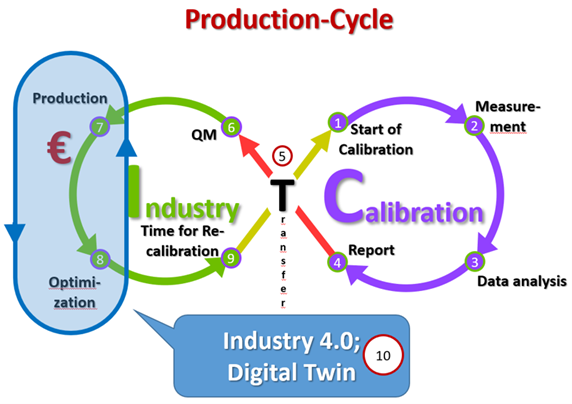
The simple calibration cycle begins with the start of the calibration procedure of a calibration item (1). Measurements follow to determine the measured value (2). Afterwards, the measurement data are analysed (create measurement uncertainty budget 3) and a calibration certificate is created (4). This is followed by the transfer (return of the calibration item to the industrial client and the calibration certificate) to the user in industry (5). There, the calibration item is registered in the quality management area (6) with all its properties (keywords are: Measuring device list, inventory number, place of inventory, further properties from the areas of accounting, controlling, sales, purchasing, production, warehousing) and is finally transferred to the production (7) and optimisation processes (8). Due to internal or external requirements, the calibration object is cyclically returned (5) to the calibration laboratory for recalibration (9), where calibration begins anew (1).
The transfer phase (5) limits the amount of information exchanged between the calibration laboratory and the client. Nowadays, however, this point is no longer about technical bandwidth issues, but about transfer and format standards, safety aspects and traceability issues in the appropriate national or international legal framework.
¶ The extended calibration cycle
This figure shows the extended calibration cycle.

This cycle differs from the simple calibration cycle in that a company operates its own calibration laboratory, which is able to provide its own working standards for internal use. To do this, the company needs a calibration item that is considered a valid traceable transfer standard. If this is given, one or more physically very similar copies with (possibly only temporarily) very similar physical properties are created from the calibration item, the so-called working standards (j). These working standards are treated in the company's own calibration laboratory () as equivalent to a calibration product which would be sent to the higher-level, accredited calibration laboratory with lower measurement uncertainty. Here, the individual calibration stages () to () are also run through analogously to (a) to (d). It should be noted that the measurement uncertainty U(UL) of the calibration by the in-house calibration laboratory is larger than the measurement uncertainty U(aCL) that an accredited calibration laboratory is able to state. The reason for this fact is that in the measurement uncertainty analysis further terms are now added which are greater than zero in magnitude. Because all measurement uncertainty terms are added quadratically, i.e. without sign, according to the specifications of the GUM, the measurement uncertainty to be stated increases. Detailed information can be found in the Guide to the Expression of Uncertainty in Measurement2 (GUM). As a result, the measurement uncertainty increases and the product quality decreases at the same time.
- BIPM - Guide to the Expression of Uncertainty in Measurement (GUM) Available online: https://www. bipm.org/en/publications/guides/gum.html (accessed on 7 February 2021).