¶ dcc:positionCoordinatesType
The element type dcc:positionCoordinatesType is used to enter location coordinates in any form of representation[1] . With it it is possible to specify coordinates of administrative maps (parcels and their names), coordinates on the world's oceans or even on other planets.
¶ Tree structure
The tree structure of the element type dcc:positionCoordinatesType has the following appearance:
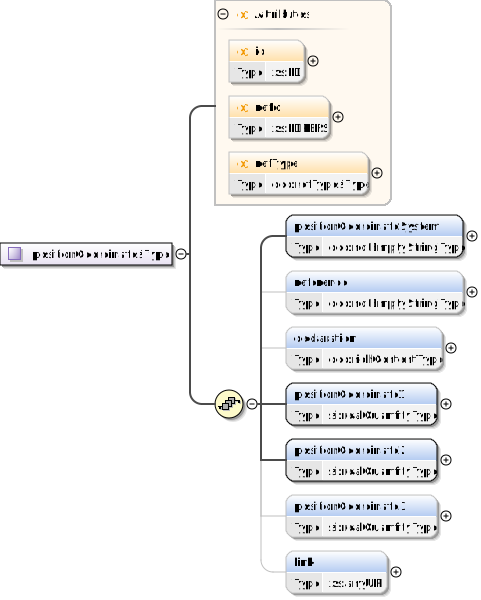
¶ Snippet from XML Schema: Type Definition "dcc:positionCoordinatesType"
<xs:complexType name="positionCoordinatesType">
  <xs:sequence>
    <xs:element name="positionCoordinateSystem" type="dcc:notEmptyStringType"/>
    <xs:element name="reference" type="dcc:notEmptyStringType" minOccurs="0"/>
    <xs:element name="declaration" type="dcc:richContentType" minOccurs="0"/>
    <xs:element name="positionCoordinate1" type="si:realQuantityType"/>
    <xs:element name="positionCoordinate2" type="si:realQuantityType"/>
    <xs:element name="positionCoordinate3" type="si:realQuantityType" minOccurs="0"/>
    <xs:element name="link" type="xs:anyURI" minOccurs="0"/>
  </xs:sequence>
  <xs:attribute name="id" type="xs:ID" use="optional"/>
  <xs:attribute name="refId" type="xs:IDREFS" use="optional"/>
  <xs:attribute name="refType" type="dcc:refTypesType" use="optional"/>
</xs:complexType>
¶ Description of the elements
See the list of abbreviations here
| Element Element type |
Use | Description |
|---|---|---|
| dcc:positionCoordinateSystem dcc:notEmptyStringType |
[M] | The system which was used to determine the position coordinates. |
| dcc:reference dcc:notEmptyStringType |
[O] | Reference more information |
| dcc:declaration dcc:richContentType |
[O] | Declaration of the position coordinates. |
| dcc:positionCoordinate1 si:realQuantityType |
[M] | First dimension of position coordinates. |
| dcc:positionCoordinate2 si:realQuantityType |
[M] | Second dimension of position coordinates. |
| dcc:positionCoordinate3 si:realQuantityType |
[O] | Third dimension of position coordinates. (Not needed with 2D coordinates) |
| dcc:link xs:anyURI |
[O] | External link to position coordinates. |
¶ Attributes
| Attribute Attribute type |
Use | Description |
|---|---|---|
| id xs:ID |
[ O] | This default XMLdataType is used to represent a unique ID. It is used to uniquely identify the object in the DCC. The data type xs:ID is deliberately used here, as this enables validation without any add-ons in various tools. |
| refId xs:IDREF |
[ O] | IDREF represents the IDREF attribute type from [XML 1.0 (Second Edition)]. The value space of IDREF is the set of all strings that match NCNameproduction in [Namespaces in XML]. The lexical space of IDREF is the set of strings that match NCNameproduction in [Namespaces in XML]. The base type of IDREF is NCName. |
| refType dcc:refTypesType |
[O] | A list of refTypes in XML. |
¶ XML Example
<dcc:positionCoordinates>
    <dcc:positionCoordinateSystem>Google GPS</dcc:positionCoordinateSystem>
    <dcc:reference>...</dcc:reference>
    <dcc:declaration>
        <dcc:content lang="en">English text...</dcc:content>
        <dcc:content lang="de">Deutscher Text...</dcc:content>
    </dcc:declaration>
    <dcc:positionCoordinate1>
        <si:label>latitude</si:label>
        <si:value>52.295251151957316</si:value>
        <si:unit>\degree</si:unit>
    </dcc:positionCoordinate1>
    <dcc:positionCoordinate2>
        <si:label>longitude</si:label>
        <si:value>10.4582905272373</si:value>
        <si:unit>\degree</si:unit>
    </dcc:positionCoordinate2>
    <dcc:link>https://maps.app.goo.gl/8V7NhcnkGaH3EpPC7</dcc:link>
</dcc:positionCoordinates>