¶ dcc:relativeUncertainty
Relative uncertainty, as required by GUM norms, cannot be implemented directly in the SI framework. Therefore, a workaround must be applied within the DCC. The relative measurement uncertainty information has to be entered in the element dcc:quantity. This entry requires that the absolute measurement uncertainty information including the k-value and the coverage probability (optionally also the distribution function) has been entered in the corresponding element si:real or si:realListXMLList and its corresponding child elements.
¶ Tree structure
The tree structure of the element type dcc:relativeUncertainty has the following appearance:
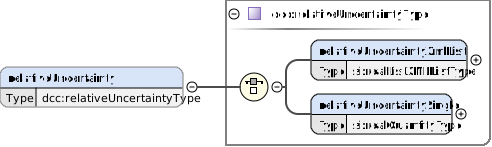
¶ Excerpt from the XML schema: type definition "relativeUncertaintyType" of the element "relativeUncertainty"
<xs:complexType name="relativeUncertaintyType">
  <xs:choice>
    <xs:element name="relativeUncertaintyXmlList" type="si:realListXMLListType" />
    <xs:element name="relativeUncertaintySingle" type="si:realQuantityType" />
  </xs:choice>
</xs:complexType>
¶ Filling-in instructions
If the dcc:quantity contains a si:real and the si:real has a si:expandedUnc then dcc:relativeUncertaintySingle can be used.
If the dcc:quantity contains a si:realListXMLList and the si:realListXMLList has a si:expandedUncXMLList then dcc:relativeUncertaintyXmlList can be used.
The item name relativeUncertaintyXmlList contains a typo. Due to backward compatibility, it cannot be changed in DCC Schema Versions prior to 4.0.0. Starting with DCC Schema Version 4.0.0, it will be renamed to relativeUncertaintyXMLList.
¶ Elements
| Element Element type |
Minimum information | Comment |
|---|---|---|
| si:realQuantityType and other si:Types DSI Wiki (external) |
[M | O] | At this point, the D-SI is integrated into the DCC to ensure that each value to be processed is specified with the corresponding metadata. |