¶ dcc:textType
This complexType can be used to represent any text. In the element content contains the multilingualism.
¶ Tree structure
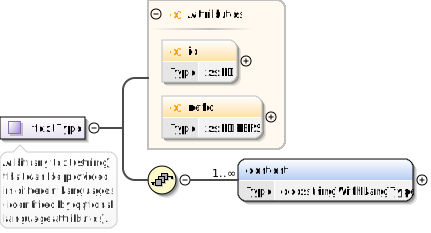
¶ Extract from the XML schema: type definition "textType"
<xs:complexType name="textType">
  <xs:sequence>
    <xs:element name="content" type="dcc:stringWithLangType" maxOccurs="unbounded"/>
  </xs:sequence>
  <xs:attribute name="id" type="xs:ID" use="optional"/>
  <xs:attribute name="refId" type="xs:IDREFS" use="optional"/>
</xs:complexType>
¶ Description of the elements
See the list of abbreviations here
| Element Element type |
Use | Description |
|---|---|---|
| dcc:content | [O] | The element is used to enter any text. The attribute "lang" is implemented for multilingualism via the data type. |
¶ Attributes
| Attribute Attribute type |
Use | Description |
|---|---|---|
| id xs:ID |
[O] | This standard dataType of XML is used to represent a unique ID. It is used to uniquely identify the object in the DCC. The data type xs:ID is deliberately used here because it enables validation without any add-ons in various tools. |
| refId xs:IDREFS |
[O] | IDREF represents the IDREF attribute type from [XML 1.0 (Second Edition)]. The value space of IDREF is the set of all strings that match the NCName production in [Namespaces in XML]. The lexical space of IDREF is the set of strings that match the NCName production in [Namespaces in XML]. The base type of IDREF is NCName. |
¶ Examples
The examples are excerpts from DCC's.
¶ Example 1
Here is a simple example without multilingualism:
<dcc:textBlock>
    <dcc:content>This is an example of the element textBlock.</dcc:content>
</dcc:textBlock>
¶ Example 2
Example 1 in the multilingual variant:
<dcc:textBlock>
    <dcc:content lang="en">This is an example of the textBlock element.</dcc:content>
    <dcc:content lang="en">This is an example of the textBlock element.</dcc:content>
</dcc:textBlock>
¶ Note
The multilingualism of text input is not handled in this element but in the child element
content of type dcc:stringWithLangType.