¶ dcc:xmlType
The data block dcc:xmlType is used to insert formulas and equations into the measurement result range of the DCC.
¶ Tree structure
The tree structure of the element type dcc:xmlType has the following appearance:
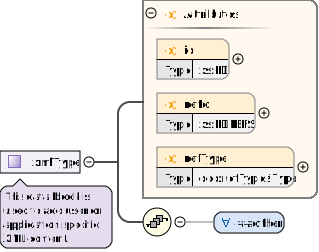
¶ Snippet from XML Schema: Type Definition "xmlType"
<xs:complexType name="xmlType">
  <xs:annotation>
    <xs:documentation>
      This data block is used to add user or application specific XML content.
    </xs:documentation>
  </xs:annotation>
  <xs:sequence>
    <xs:any namespace="##other" minOccurs="0" />
  </xs:sequence>
  <xs:attribute name="id" type="xs:ID" use="optional" />
  <xs:attribute name="refId" type="xs:IDREF" use="optional" />
  <xs:attribute name="refType" type="xs:string" use="optional" />
</xs:complexType>
¶ Elements
xs:any is a wildcard that allows you to insert any element that belongs to one of several namespaces. This element canbe used within selections (xs:choice) and sequences (xs:sequence) just like xs:element. The frequency of occurrence of the approved elements can be controlled by the minOccurs and maxOccurs attributes of these particles.
The list of allowed namespaces is specified using the namespace attribute. This attribute expects an enumeration of namespace URls.
Further information can be found at:
https://www.data2type.de/xml-xslt-xslfo/xml-schema/element-referenz/xs-any
<xs:any
id =  xs:id
maxOccurs = (  xs:nonNegativeInteger  | "unbounded" ) : "1"
minOccurs =  xs:nonNegativeInteger  : "1"
namespace =  ( (  "##any"| " ##other") | list  of (  xs:anyURI  | ( "## targetNamespace" | " ##local" ) ) ): "##any"
processContents =  ( "skip"| " lax" | "strict" ): "strict"
    {any attributes with a non-schema namespace}
    >
    Content: (xs:annotation?)
</xs:any>
¶ Attributes
| Attribute attribute type |
Minimum details | Remark |
|---|---|---|
| id xs:ID |
[O] | This default XMLdataType is used to represent a unique ID. It is used to uniquely identify the object in the DCC. The data type xs:ID is deliberately used here, as this enables validation without any add-ons in various tools. |
| refId xs:IDREFS |
[O] | IDREF represents the IDREF attribute type from [XML 1.0 (Second Edition)]. The value space of IDREF is the set of all strings that match NCNameproduction in [Namespaces in XML]. The lexical space of IDREF is the set of strings that match NCNameproduction in [Namespaces in XML]. The base type of IDREF is NCName. |
| refType dcc:refTypesType |
[O] | A list of refTypes in XML. |
¶ MathML
The xmlType of dcc is intended for use of MathML too. Keep in mind that the xmlType is stricted and it is needed to present a schema for the validation process. Otherwise the validation of the DCC results into an error.
¶ Snippet example of MathML
<dcc:mathml>
  <ml:math xmlns:ml="http://www.w3.org/1998/Math/MathML" xsi:schemaLocation="http://www.w3.org/1998/Math/MathML https://www.w3.org/Math/XMLSchema/mathml3/mathml3.xsd">
    <ml:mrow>
      <ml:msup>
        <ml:mfenced>
          <ml:mrow>
            <ml:mi>a</ml:mi>
            <ml:mo>+</ml:mo>
            <ml:mi>b</ml:mi>
          </ml:mrow>
        </ml:mfenced>
       <ml:mn>2</ml:mn>
      </ml:msup>
    </ml:mrow>
  </ml:math>
</dcc:mathml>
A guide how to use MathML in xml can be found here: https://www.w3.org/TR/MathML3/