¶ FAQ "Adjustment & Repair"
A calibration certificate often includes measured values that are outdated due to adjustments or repairs. These values can still be included in the calibration certificate under the terms 'as found' and 'as left'. There are two possible solutions.
¶ Solution 1
The first possible solution is to store results obtained prior to an adjustment or repair in an dcc:influenceCondition of a dcc:measurementResult and to store the measurement results obtained after an adjustment or repair in the dcc:result of a dcc:measurementResult.
Let's examine dcc:result, where current results are stored, and dcc:influenceCondition, which holds outdated or historical results.
The current and past results share the same structure as a dcc:dataType.
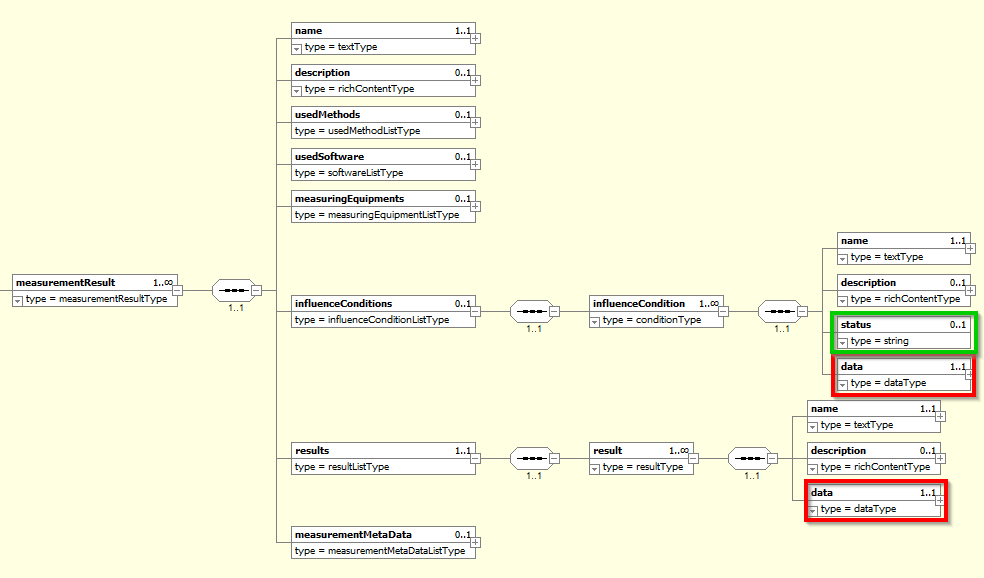
Both elements contain the dcc:data element (outlined in red in the image). All measured values are stored in the dcc:data element. This double use of the dataType as the dcc:data element allows a data element to be moved from the dcc:result to the dcc:influenceCondition without changing the measured values. The type of measured values is entered in the dcc:status element (outlined in green in the image).
Possible values for dcc:status are:
afterAdjustment
afterRepair
beforeAdjustment
beforeRepair
¶ Example
It is possible to input data from previous DCCs and to input data from measurements before and after adjustments.
The graphic illustrates two DCCs created at different times, with DCC1 preceding DCC2.
DCC1 contains only of a calibration, with no adjustments or repairs or data related to a previous DCC. The data is stored in the dcc:result/dcc:data section.
DCC2 integrates the data from DCC1 as well as a measurement carried out before the adjustment and the actual calibration. Both measurements follow the same procedure and provide results with the same structure. However, due to the adjustment, the values from the first measurement are no longer up-to-date. The values from the first measurement are marked with the status before the adjustment (dcc:status) and saved in a section dcc:influenceCondition.
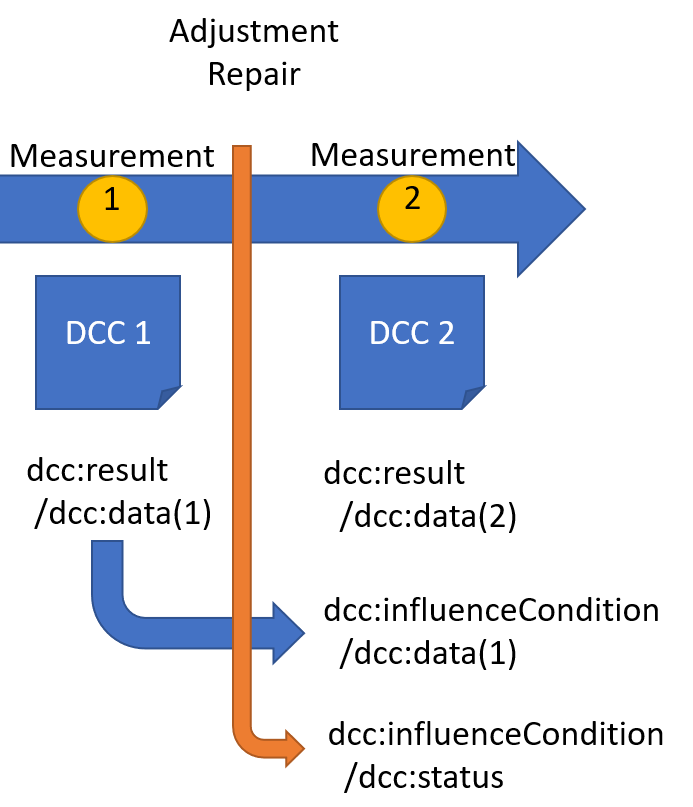
Regarding Solution 1: When including measurement data from a previous DCC and adding adjustment information in the same DCC, ensure the following: when specifying usedMethods, usedSoftware, measuringEquipments and influenceContions for the most recent measurement, don't use the dcc:status element in dcc:measurementResult.
¶ Solution 2
The second solution is to store each result in different dcc:measurementResult items and place an dcc:influenceCondition in each dcc:measurementResult. Each of these dcc:influenceCondition in dcc:measarumentResult has to contain a dcc:status stating whether the corresponding dcc:measurementResult is beforeAdjustment, afterAdjustment, beforeRepair or afterRepair.
¶ Example
<dcc:administrativeData>
    ...
   <dcc:items>
         <dcc:item id="item1">
            ...
         </dcc:item>
   </dcc:items>
   ...
</dcc:administrativeData>
<dcc:measurementResults refId="item1">
   <dcc:measurementResult>
      <dcc:influenceConditions>
         <dcc:influenceCondition refType="basic_adjustment">
            <dcc:name>
               <dcc:content>Calibration before adjustment</dcc:content>
            </dcc:name>
            <dcc:status>beforeAdjustment</dcc:status>
         </dcc:influenceCondition>
         ...
      </dcc:influenceConditions>
      ...
   </dcc:measurementResult>
   <dcc:measurementResult refId="item1">
      <dcc:influenceConditions>
         <dcc:influenceCondition refType="basic_adjustment">
            <dcc:name>
               <dcc:content>Calibration after adjustment</dcc:content>
            </dcc:name>
            <dcc:status>afterAdjustment</dcc:status>
         </dcc:influenceCondition>
         ...
      </dcc:influenceConditions>
   ...
   </dcc:measurementResult>
</dcc:measurementResults>
For a detailed example please have a look at the DKD Expert report for weights and weight sets [1] at chapter 4.3