¶ dcc:influenceConditionType
The dcc:influenceConditionListType offers the possibility to specify several elements of the type dcc:influenceConditionType. This type can be called in the element dcc:measurementResult, dcc:list and dcc:quantity. Thus, the element has a validity for a whole dcc:measurementResult, a whole dcc:list or a single dcc:quantity, respectively.
In dcc:influenceConditionType conditions are described which have influence on the calibration results. In this type, it is also possible to store the measurement values that are no longer current if a repair or adjustment was carried out on the calibration item.
¶ Tree structure
The tree structure of the type dcc:influenceConditionListType has the following appearance:

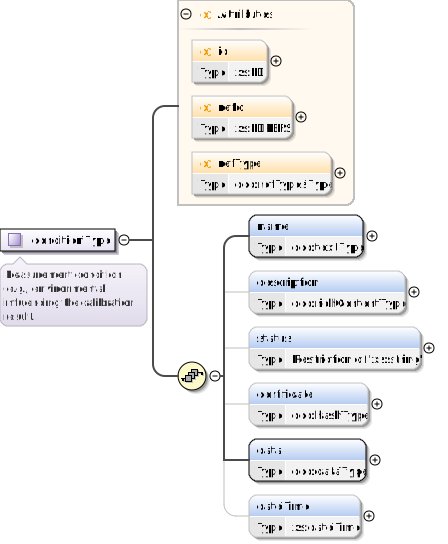
The tree structure of the type dcc:conditionType has the following appearance:
¶ Extract from the XML schema: type definition "influenceConditionListType"
<xs:complexType name="influenceConditionListType">
    <xs:sequence>
        <xs:element name="influenceCondition" type="dcc:conditionType" maxOccurs="unbounded"/>
    </xs:sequence>
</xs:complexType>
¶ Extract from the XML schema: type definition "conditionType"
Conditions (e.g. environmental conditions) under which the calibrations were performed and which have an influence on the measurement results.
<xs:complexType name="conditionType">
  <xs:sequence>
    <xs:element name="name" type="dcc:textType"/>
    <xs:element name="description" type="dcc:richContentType" minOccurs="0"/>
    <xs:element name="status" minOccurs="0">
      <xs:simpleType>
        <xs:restriction base="xs:string">
          <xs:enumeration value="beforeAdjustment"/>
          <xs:enumeration value="afterAdjustment"/>
          <xs:enumeration value="beforeRepair"/>
          <xs:enumeration value="afterRepair"/>
        </xs:restriction>
      </xs:simpleType>
    </xs:element>
    <xs:element name="certificate" type="dcc:hashType" minOccurs="0"/>
    <xs:element name="data" type="dcc:dataType"/>
  </xs:sequence>
  <xs:attribute name="id" type="xs:ID" use="optional"/>
  <xs:attribute name="refId" type="xs:IDREFS" use="optional"/>
  <xs:attribute name="refType" type="dcc:refTypesType" use="optional"/>
</xs:complexType>
¶ Description of the elements
See the list of abbreviations here
| Element Element type |
Use | Description |
|---|---|---|
| dcc:name dcc:textType |
[M] | In this element, the name of the condition (e.g. environmental condition) under which the calibrations were performed and which has an influence on the measurement result is entered. |
| dcc:description dcc:richContentType |
[O] | The element type dcc:richContentType is used to enter any information. With it, it is possible to accommodate text as well as images and formulas in one element. |
| dcc:status xs:string |
[O] | The status can be: - beforeAdjustment, - afterAdjustment, - beforeRepair, - afterRepair. It indicates a change due to a repair or adjustment of the unit, making the information in dcc:data history data. |
| dcc:certificate dcc:hashType |
[O] | Reference to another certificate as the source of the values. |
| dcc:data dcc:dataType |
[M] | without dcc:status: The element dcc:data contains the data of the influence conditions. with dcc:status: The element contains the history data before a change was made to the device. |
¶ Attributes
| Attribute Attribute type |
Use | Description |
|---|---|---|
| id xs:ID |
[O] | This standard XML data type is used to represent a unique ID. It is used to uniquely identify the object in the DCC. The data type xs:ID is deliberately used here because it enables validation without any add-ons in various tools. |
| refId xs:IDREFS |
[O] | IDREF represents the IDREF attribute type from [XML 1.0 (Second Edition)]. The value space of IDREF is the set of all strings that match the NCName production in [Namespaces in XML]. The lexical space of IDREF is the set of strings that match the NCName production in [Namespaces in XML]. The base type of IDREF is NCName. |
| refType dcc:refTypesType |
[O] | A list of refTypes in XML. |