¶ dcc:quantityType
A single measurand that may contain a D-SI element or text. Each value describing a physical quantity is placed in a dcc:quantity. The DCC uses the XML schema of the D-SI, which ensures that each numerical value is also specified with its corresponding metadata.
In addition, methods used, software used and influence conditions that only affect this quantity can be added. Metadata can also be added, such as a conformity assessment.
¶ Tree structure
The tree structure of the element type dcc:quantityType has the following appearance:
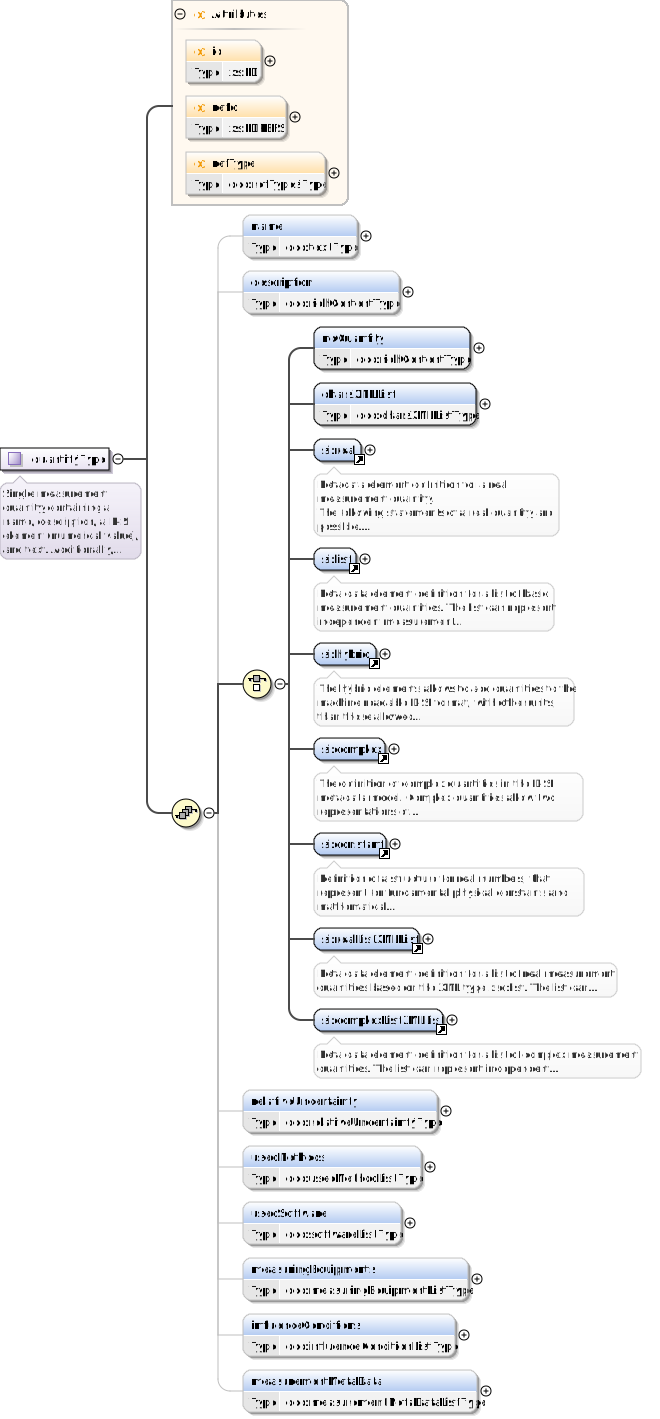
¶ Extract from the XML schema: type definition "quantityType"
<xs:complexType name="quantityType">
  <xs:sequence>
    <xs:element name="name" type="dcc:textType" minOccurs="0"/>
    <xs:element name="description" type="dcc:richContentType" minOccurs="0"/>
    <xs:choice>
      <xs:element name="noQuantity" type="dcc:richContentType"/>
      <xs:element name="charsXMLList" type="dcc:charsXMLListType"/>
      <xs:element ref="si:real"/>
      <xs:element ref="si:list"/>
      <xs:element ref="si:hybrid"/>
      <xs:element ref="si:complex"/>
      <xs:element ref="si:constant"/>
      <xs:element ref="si:realListXMLList"/>
      <xs:element ref="si:complexListXMLList"/>
    </xs:choice>
    <xs:element name="relativeUncertainty" type="dcc:relativeUncertaintyType" minOccurs="0" />
    <xs:element name="usedMethods" type="dcc:usedMethodListType" minOccurs="0"/>
    <xs:element name="usedSoftware" type="dcc:softwareListType" minOccurs="0"/>
    <xs:element name="measuringEquipments" type="dcc:measuringEquipmentListType" minOccurs="0"/>
    <xs:element name="influenceConditions" type="dcc:influenceConditionListType" minOccurs="0"/>
    <xs:element name="measurementMetaData" type="dcc:measurementMetaDataListType" minOccurs="0"/>
  </xs:sequence>
  <xs:attribute name="id" type="xs:ID" use="optional"/>
  <xs:attribute name="refId" type="xs:IDREFS" use="optional"/>
  <xs:attribute name="refType" type="dcc:refTypesType" use="optional"/>
</xs:complexType>
¶ Description of the elements
See the list of abbreviations here
| Element Element type |
Use | Description |
|---|---|---|
| dcc:name dcc:textType |
[O] | This element can be used to store text specifying the language used. |
| dcc:description dcc:richContentType |
[O] | Description of the Quantity. The element type dcc:richContentType is used to enter any information. With it, it is possible to accommodate text as well as images and formulas in one element. |
| dcc:noQuantity dcc:richContentType |
[O|M] | The element type dcc:richContentType is used to enter any information. With it, it is possible to accommodate text as well as images and formulas in one element. |
| dcc:charsXMLList dcc:charsXMLListType |
[O|M] | The element type dcc:charsXMLListType is used to enter characters. |
| si:real and other si:Types DSI Wiki (external) |
[O|M] | At this point, the D-SI is integrated into the DCC to ensure that each value to be processed is specified with the corresponding metadata. |
| dcc:relativeUncertainty dcc:relativeUncertaintyType |
[O] | Relative Uncertainty of the D-SI according to GUM is implemented here. |
| dcc:usedMethods dcc:usedMethodListType |
[O] | List of methods used during calibration. It is possible that a method has already been named in a parent element, which is also valid for this dcc:quantity. |
| dcc:usedSoftware dcc:softwareListType |
[O] | List of software used to create and edit the quantity are stored here. It is possible that software has already been named in a parent element, which is also valid for this dcc:quantity. |
| dcc:measuringEquipments dcc:measuringEquipmentListType |
[O] | Measuring equipments can be specified here. It is possible that a piece of equipment has already been named in a higher-level element, which is also valid for this dcc:quantity. |
| dcc:influenceConditions dcc:influenceConditionListType |
[O] | Conditions which have influence on the calibration results in this quantity. It is possible that a condition has already been named in a higher-level element, which is also valid for this dcc:quantity. |
| dcc:measurementMetaData dcc:measurementMetaDataListType |
[O] | A list of meta data regarding the quantity it is located in. |
¶ Attributes
| Attribute Attribute type |
Use | Description |
|---|---|---|
| id xs:ID |
[O] | This standard XML data type is used to represent a unique ID. It is used to uniquely identify the object in the DCC. The data type xs:ID is deliberately used here because it enables validation without any add-ons in various tools. |
| refId xs:IDREFS |
[O] | IDREF represents the IDREF attribute type from [XML 1.0 (Second Edition)]. The value space of IDREF is the set of all strings that match the NCName production in [Namespaces in XML]. The lexical space of IDREF is the set of strings that match the NCName production in [Namespaces in XML]. The base type of IDREF is NCName. |
| refType dcc:refTypesType |
[O] | This attribute allows a list of refTypes. |