¶ dcc:statement
With the help of the element type dcc:statementListType and the dcc:statementMetaDataType, statements on calibration are stored which apply to the entire calibration process.
¶ Tree structure
The tree structure of the element type dcc:statementListType has the following appearance:
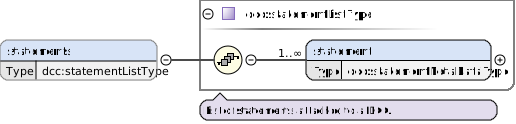
The tree structure of the element type dcc:measurementMetaDataListType has the following appearance:

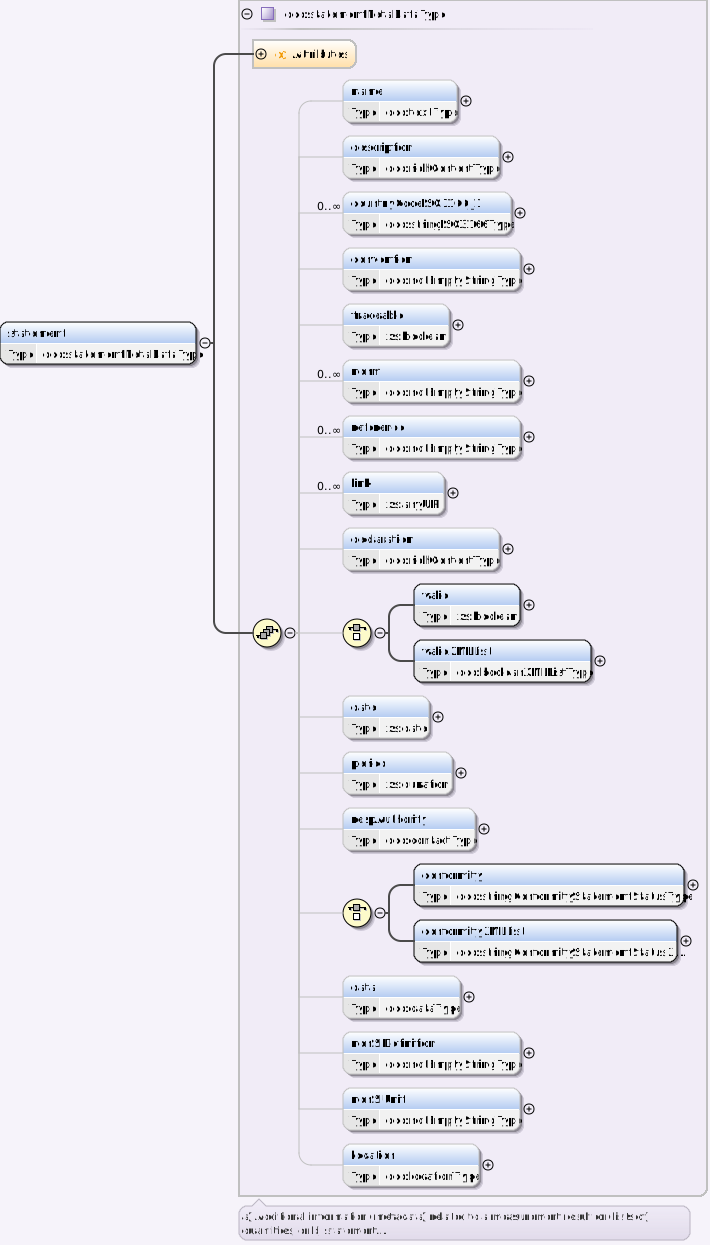
The tree structure of the element type dcc:statementMetaDataType has the following appearance:
¶ Extract from the XML schema: type definition "dcc:statementListType"
<xs:complexType name="statementListType">
   <xs:sequence>
        <xs:element name="statement" type="dcc:statementMetaDataType" maxOccurs="unbounded"/>
   </xs:sequence>
</xs:complexType>
¶ Extract from the XML schema: type definition "dcc:statementMetaDataType"
<xs:complexType name="statementMetaDataType">
  <xs:sequence>
    <xs:element name="name" type="dcc:textType" minOccurs="0"/>
    <xs:element name="description" type="dcc:richContentType" minOccurs="0"/>
    <xs:element name="countryCodeISO3166_1" type="dcc:stringISO3166Type" minOccurs="0"
                maxOccurs="unbounded"/>
    <xs:element name="convention" type="dcc:notEmptyStringType" minOccurs="0"/>
    <xs:element name="traceable" type="xs:boolean" minOccurs="0"/>
    <xs:element name="norm" type="dcc:notEmptyStringType" minOccurs="0" maxOccurs="unbounded"/>
    <xs:element name="reference" type="dcc:notEmptyStringType" minOccurs="0" maxOccurs="unbounded"/>
    <xs:element name="link" type="xs:anyURI" minOccurs="0" maxOccurs="unbounded"/>
    <xs:element name="declaration" type="dcc:richContentType" minOccurs="0"/>
    <xs:choice minOccurs="0">
      <xs:element name="valid" type="xs:boolean"/>
      <xs:element name="validXMLList" type="dcc:booleanXMLListType"/>
    </xs:choice>
    <xs:element name="date" type="xs:date" minOccurs="0"/>
    <xs:element name="period" type="xs:duration" minOccurs="0"/>
    <xs:element name="respAuthority" type="dcc:contactType" minOccurs="0"/>
    <xs:choice minOccurs="0">
      <xs:element name="conformity" type="dcc:stringConformityStatementStatusType"/>
      <xs:element name="conformityXMLList" type="dcc:stringConformityStatementStatusXMLListType"/>
    </xs:choice>
    <xs:element name="data" type="dcc:dataType" minOccurs="0"/>
    <xs:element name="nonSIDefinition" type="dcc:notEmptyStringType" minOccurs="0"/>
    <xs:element name="nonSIUnit" type="dcc:notEmptyStringType" minOccurs="0"/>
    <xs:element name="location" type="dcc:locationType" minOccurs="0"/>
  </xs:sequence>
  <xs:attribute name="id" type="xs:ID" use="optional"/>
  <xs:attribute name="refId" type="xs:IDREFS" use="optional"/>
  <xs:attribute name="refType" type="dcc:refTypesType" use="optional"/>
</xs:complexType>
¶ Description of the elements
See the list of abbreviations here
| Element Element type |
Use | Description |
|---|---|---|
| dcc:name dcc:textType |
[O] | This element specifies the name of the statement. |
| dcc:description dcc:richContentType |
[O] | Descriptive information about the statement can be specified in this element. Text as well as images and formulas can be stored in this element. |
| dcc:countryCodeISO3166_1 dcc:stringISO3166Type |
[O] | Country code for this statement [1]. |
| dcc:convention dcc:notEmptyStringType |
[O] | Convention followed for this statement. |
| dcc:traceable xs:boolean |
[O] | Indicates whether the measurement result is traceable [2]. Boolean has the value space required to support the mathematical concept of binary-valued logic: {true, false}. |
| dcc:norm dcc:notEmptyStringType |
[O] | Reference is made here to the standards and guidelines that were taken into account in the measurement |
| dcc:reference dcc:notEmptyStringType |
[O] | The String data type represents strings in XML. more information |
| dcc:link xs:anyURI |
[O] | External link(s) to the statement. |
| dcc:declaration dcc:richContentType |
[O] | Declarative information as the main information of the statement can be specified in this element e.g., a definition, a declaration etc. Text as well as images and formulas can be stored in this element. |
| dcc:valid xs:boolean |
[O] | Indicates that the result is in valid range. |
| dcc:validXMLList dcc:booleanXMLListType |
[O] | This element is used to specify foot notes for si:realListXMLList. dcc:validXMLList |
| dcc:date xs:date |
[O] | Fill in a valid date. |
| dcc:period xs:duration |
[O] | DIN ISO 8601-1:2020-12 Date and time - Presentation for the exchange of information - Part 1: Basic rules (ISO 8601-1:2019) doi: 10.31030/3178552[3] |
| dcc:respAuthority dcc:contactType |
[O] | Information about a responsible authority, in regards to the statement it is defined in, can be specified here by contact information. |
| dcc:conformity dcc:stringConformityStatementStatusType |
[O] | Used to enter compliance statements. |
| dcc:conformityXMLList dcc:stringConformityStatementStatusXMLListType |
[O] | Used to enter compliance statements in a XMLList. |
| dcc:data dcc:dataType |
[O] | With the help of the element type dcc:dataType different data formats are made known. |
| dcc:nonSIDefinition dcc:notEmptyStringType |
[O] | Definition of a non-SI unit used by the DCC. |
| dcc:nonSIUnit dcc:notEmptyStringType |
[O] | The used non-SI unit used by the DCC. |
| dcc:location dcc:locationType |
[O] | An additional location can be described here. |
¶ Attributes
| Attribute Attribute type |
Use | Description |
|---|---|---|
| id xs:ID |
[O] | This standard XML data type is used to represent a unique ID. It is used to clearly identify the object in the DCC. The data type xs:ID is deliberately used here, as this enables validation in various tools without any add-ons. |
| refId xs:IDREFS |
[O] | IDREFS represents the IDREFS attribute type from [XML 1.0 (Second Edition)]. The ·value space· of IDREFS is the set of finite, non-zero-length sequences of IDREFs. The ·lexical space· of IDREFS is the set of space-separated lists of tokens, of which each token is in the ·lexical space· of IDREF. The ·itemType· of IDREFS is IDREF. |
| refType dcc:refTypesType |
[O] | An XML List to link to reference types. |
¶ Examples
The calibration certificate was created according to ISO/IEC 17025.
<dcc:statement>
  <dcc:norm>ISO/IEC 17025:2018</dcc:norm>
  <dcc:declaration>
    <dcc:content lang="en">It is hereby confirmed that the calibration certificate has been issued in accordance with ISO/IEC 17025:2018. (if applicable, the same sentence that already appears on the analogue calibration certificate).
    </dcc:content>
    <dcc:content lang="de">Hiermit wird bestätigt, dass der Kalibrierschein nach der ISO/IEC 17025:2018 erstellt wurde. (ggf. der selbe Satz der bereits auf dem Analogen Kalibrierschein steht.)</dcc:content>
  </dcc:declaration>
</dcc:statement>
The client, Company XY, specifies the conditions for the declaration of conformity. The statement refers to an overall statement of conformity for the entire calibration certificate.
If the statement of conformity refers generally to a standard or other document that applies to the entire DCC, it belongs in a statement. The direct comparison values (numerical values) are specified on the dcc:quantity or dcc:list to be evaluated under dcc:measurmentMetaData.
<dcc:statement refType="/conformity">
  <dcc:convention>Conformity statement/ Konformitätsaussage</dcc:convention>
  <dcc:declaration>
    <dcc:content lang="en">The conditions for the conformity statement were specified by Company XY.
    </dcc:content>
    <dcc:content lang="de">Die Bedingungen für die Konformitätsaussage wurde von Company XY vorgegeben.
    </dcc:content>
  </dcc:declaration>
  <dcc:resposibleAuthority>
    <dcc:name>
      <dcc:content>Company XY</dcc:content>
    </dcc:name>
    <dcc:eMail>xy@CompanyXY.com</dcc:eMail>
    <dcc:location>
      <dcc:city>Berlin</dcc:city>
      <dcc:postCode>10587</dcc:postCode>
      <dcc:countryCode>DE</dcc:countryCode>
    </dcc:location>
  </dcc:resposibleAuthority>
  <dcc:conformity>pass</dcc:conformity>
</dcc:statement>
The calibration certificate was issued by a DAkkS accredited laboratory.
The laboratory number assigned by the accreditation body has to be entered at dcc:calibrationLaboratoryCode under dcc:calibrationLaboratory.
<dcc:statement id="dakks" refType="accreditation" >
    <dcc:declaration>
    <dcc:content lang="en">This calibration certificate documents the metrological traceability to national standards, which realize the units of measurement according to the International System of Units (SI).The DAkkS is signatory to the multilateral agreements of the European co-operation for Accreditation (EA) and of the International Laboratory Accreditation Cooperation (ILAC) for the mutual recognition of calibration certificates. The user is obliged to have the object recalibrated at appropriate intervals.</dcc:content>
        <dcc:content lang="de">Dieser Kalibrierschein dokumentiert die metrologische Rückführbarkeit auf nationale Normale zur Darstellung der Einheiten in Übereinstimmung mit dem Internationalen Einheitensystem (SI). Die DAkkS ist Unterzeichner der multilateralen Übereinkommen der European co-operation for Accreditation (EA) und der International Laboratory Accreditation Cooperation (ILAC) zur gegenseitigen Anerkennung der Kalibrierscheine. Für die Einhaltung einer angemessenen Frist zur Wiederholung der Kalibrierung ist der Benutzer verantwortlich.</dcc:content>
    </dcc:declaration>
  <dcc:valid>true</dcc:valid>
</dcc:statement>
Further remarks can be added with dcc:declaration.
<dcc:statement>
    <dcc:declaration>
    <dcc:content lang="en">remarks</dcc:content>
        <dcc:content lang="de">Bemerkungen</dcc:content>
  </dcc:declaration>
</dcc:statement>

Since the dcc:statementMetaDataType is a very universal type, the use cases are listed separately.